
Questions?
Call (800) 583-4891
Answer a few questions to find the right product for your project.
Buyer's Guide · Erosion Control
Bare soil on a slope or in a channel won't stay put. The right erosion control product holds the soil, protects your seed, and helps vegetation take over — the question is whether you need a temporary blanket or a permanent mat.
Every job comes down to the same goal: keep soil in place long enough for vegetation to establish and hold it permanently. The difference between the two families is simply how long they need to last — which depends on how steep your slope is and how much water moves across it.
The Two Families
A biodegradable or photodegradable cover that protects seed and soil while grass establishes, then breaks down as the new turf takes over. Best for slopes and low-to-moderate flow. Made from straw, coconut, or excelsior (wood) fiber. Browse erosion control blankets.
A long-term, three-dimensional matrix that won't break down — it reinforces mature roots for steep slopes, banks, and high-flow vegetated channels where a blanket won't hold and riprap would be overkill. Browse turf reinforcement mats.

Temporary Cover
An erosion control blanket (ECB) is laid over a freshly seeded slope to shield the seed from wind and birds and to hold the soil while grass germinates. It gives seedlings a structure to grow up through, then gradually breaks down as the established turf takes over the work of holding the soil. Depending on the fiber and netting, blankets range from short-term to longer-functioning — a great fit for slopes and areas with low to moderate water flow.
Blanket Materials
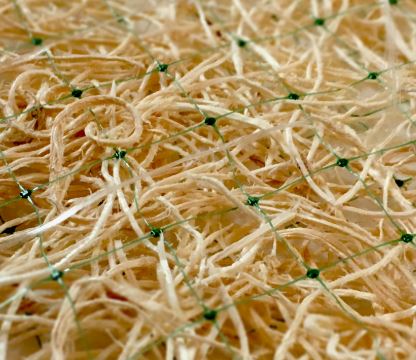
Three fibers cover most projects. Straw blankets are the economical choice for shorter-term cover on milder slopes. Coconut blankets use a longer-functioning fiber that holds up in wetter conditions and on steeper ground. Excelsior (curled wood fiber) forms a springy matrix that nestles tight to the soil and resists movement.
Our excelsior line steps up by slope — Curlex I for gentler grades, Curlex II for moderate, and Curlex III for steeper ground — while Curlex NetFree removes the netting entirely for mowing- and wildlife-sensitive sites. Nettings come in photodegradable and biodegradable options, which control how the blanket eventually breaks down.
Seed First
These blankets do not come pre-seeded. You choose your own grass seed — ideally a native variety approved by your municipality — and seed before the blanket goes down. The product protects the seed; the grass provides the permanent hold.
Permanent Reinforcement
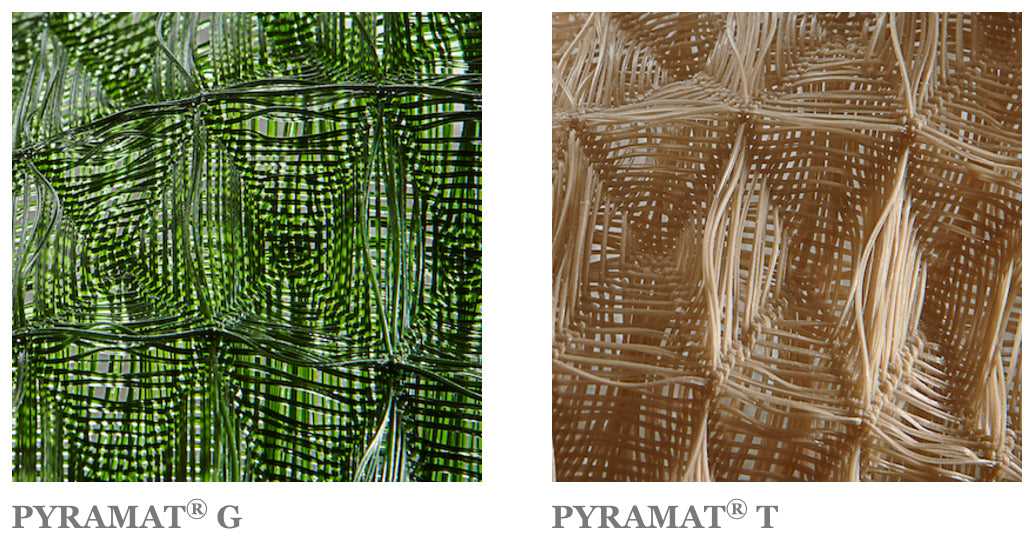
When a slope is too steep or a channel carries too much water for a temporary blanket, a turf reinforcement mat (TRM) is the answer. TRMs are permanent — a three-dimensional matrix (woven polypropylene, or 100% recycled fibers) that interlocks with soil and roots, slows water at ground level, and reinforces vegetation for the long haul.
High-performance mats like Pyramat carry design lives up to roughly 25 to 75 years, withstand high shear stress and flow velocity, and are recognized by the EPA and FHWA as a best management practice for water quality.
Making the Call
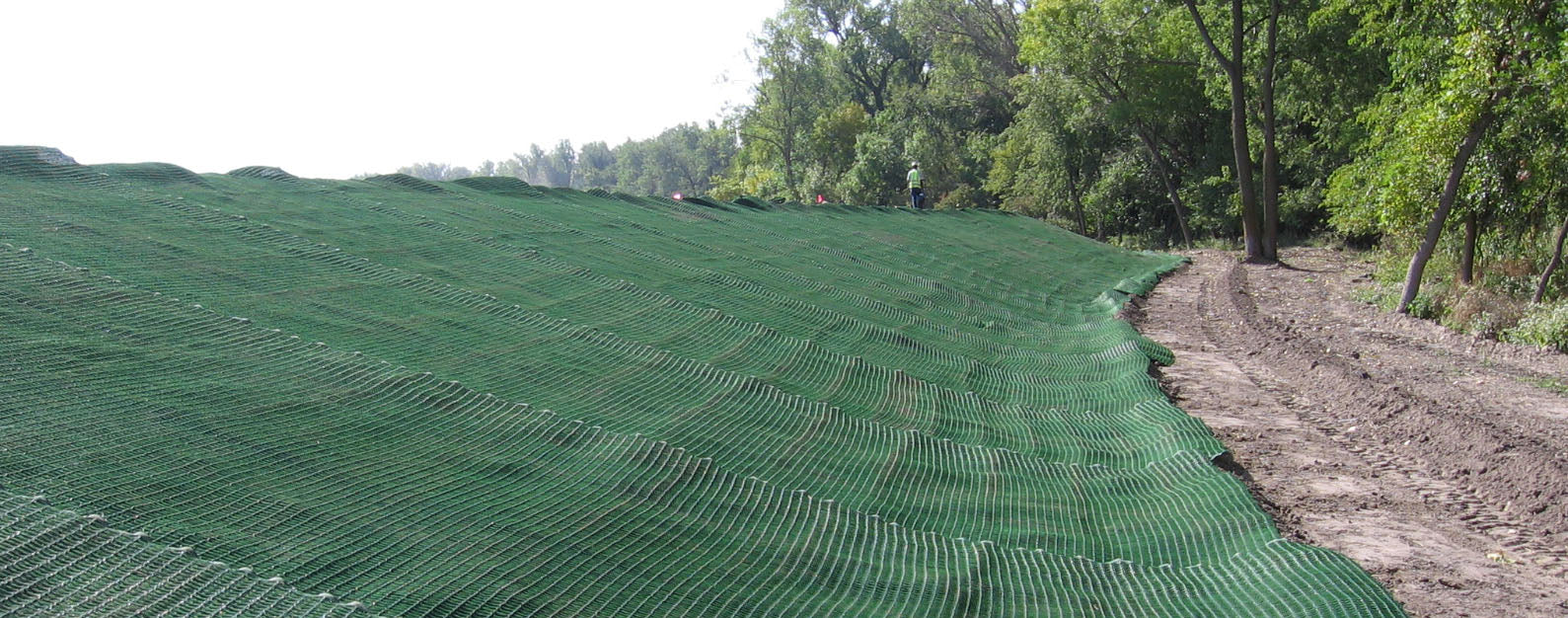
Two factors drive the decision: how steep the slope is, in degrees, and how fast water moves across it. A gentle slope with light flow needs only a temporary blanket while grass establishes. As the slope steepens and flow picks up, step up to a longer-functioning coconut blanket — and for steep banks, shorelines, and vegetated channels with sustained flow, move to a permanent TRM. The steeper and wetter the site, the more permanent the product needs to be.
The Progression

Installation Basics
Install runs the same way for both families. Roll the product down the slope, or in the direction of flow in a channel. Trench in the top edge so water can't get underneath, overlap seams about 6 inches, and staple or anchor per the manufacturer's spec — with denser anchoring at edges, seams, and transitions.
For TRMs, you can lay the mat directly over the seedbed or use the soil-fill method (a thin soil veneer over the mat before seeding) to drive fast, dense vegetation.
Quick Decision Checklist
What We Carry
We carry a full erosion-control range — from Curlex excelsior blankets and the net-free Curlex NetFree, to permanent turf reinforcement mats including Pyramat, Recyclex, Landlok, and Curlex Enforcer — covering everything from a quick straw blanket to a 75-year high-performance channel mat. See the full erosion control product guide.
Common Questions
No — neither comes with seed. Prepare a fine, compacted seedbed, sow a native grass variety approved by your municipality, then install the blanket or mat over the top so vegetation grows up through it.
Step up to a turf reinforcement mat when the slope is too steep or the channel carries too much water for a temporary blanket to hold — steep banks, shorelines, and vegetated channels with sustained flow. TRMs are permanent and reinforce mature roots for the long haul.
Blankets are temporary and break down as turf takes over, with straw the shortest-term and coconut or excelsior longer-functioning. High-performance TRMs like Pyramat carry design lives of roughly 25 to 75 years.
Roll down the slope, or in the direction of flow in a channel. Trench in the top edge, overlap seams about 6 inches, and anchor per spec with denser stapling at edges, seams, and transitions.
Nothing — every order ships free.