
Questions?
Call (800) 583-4891
EnkaSonic is an impact-sound insulation underlay for floating floor build-ups. Its engineered core decouples the floor from the structure to reduce footfall and impact noise between levels — available in multiple thicknesses to match your acoustic and build-height requirements.
Guide
Footsteps, dropped objects, and moving furniture all create impact noise — sound that travels through the floor structure into the rooms below. In apartments, condos, hotels, and multi-level buildings, controlling that noise is often a code requirement and a major comfort issue.
EnkaSonic is an acoustic underlay that sits beneath a floating floor build-up. Its engineered core separates — or "decouples" — the finished floor from the structural slab below, interrupting the path that impact sound would otherwise travel and noticeably reducing footfall noise between levels.
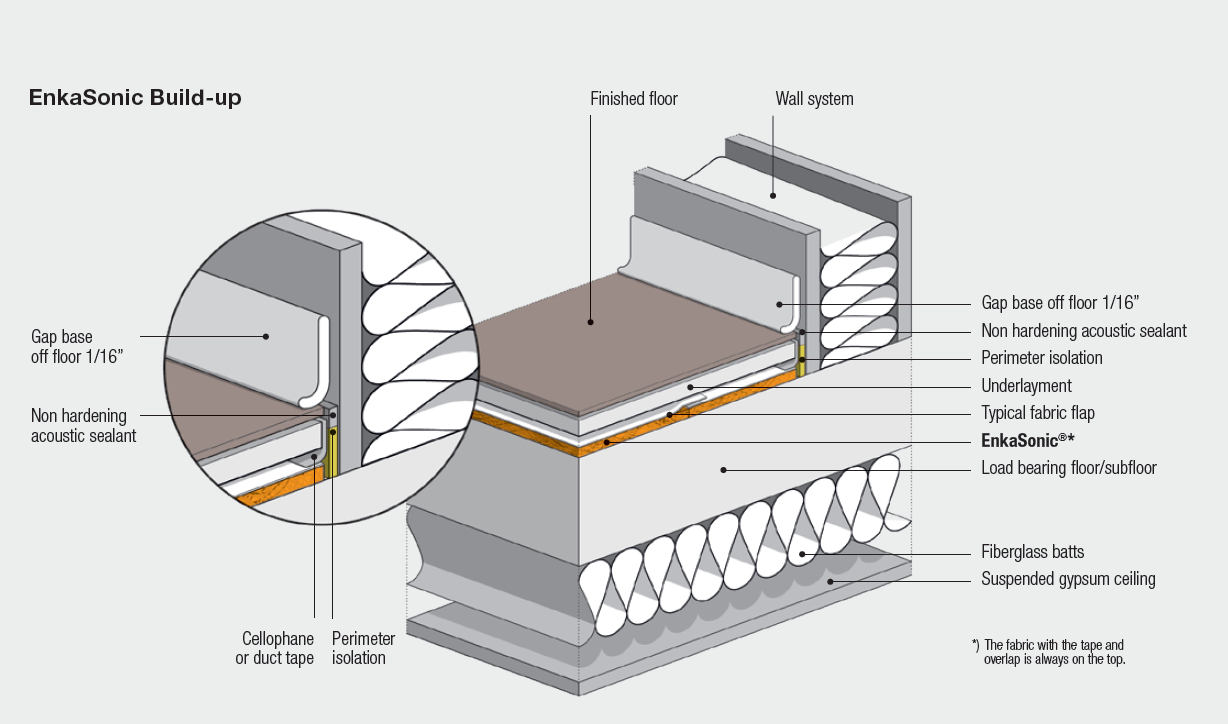
Impact noise happens when an object strikes the floor and the energy passes straight into the slab, which then radiates sound into the space below. A "floating floor" breaks that connection.
Decoupling: EnkaSonic creates a resilient layer between the slab and the floor build-up above it, so the two are no longer rigidly connected. The underlay absorbs and dampens impact energy instead of letting it pass straight through.
Floating build-up: A screed or board layer sits on top of the underlay, isolated from the structure at the perimeter as well, so the finished floor effectively "floats." This is what gives the assembly its impact-sound performance.
Thicker EnkaSonic products generally provide more separation and higher impact-sound reduction, which is why the line is offered in several thickness tiers.
EnkaSonic is offered in several series. All rolls are 39" wide; the roll length decreases as the underlay gets thicker, so heavier acoustic tiers cover less area per roll. Use this as a quick reference when planning coverage — full specs are on each product page.
| Product | Roll size | Tier |
|---|---|---|
| EnkaSonic 125 A-105 | 39" × 285' | Thinnest / most coverage per roll |
| EnkaSonic 250 A-106 | 39" × 145' | Mid |
| EnkaSonic 250 A-109 Plus | 39" × 110' | Mid (Plus) |
| EnkaSonic 400 A-110 | 39" × 90' | Thicker |
| EnkaSonic 400 A-113 Plus | 39" × 80' | Thicker (Plus) |
| EnkaSonic 750 A-114 | 39" × 48' | Thickest |
| EnkaSonic 750 A-116 Plus | 39" × 46' | Thickest (Plus) |
Rule of thumb: higher series numbers indicate a thicker underlay, which generally means greater impact-sound separation but less coverage per roll. Match the series to the acoustic performance your project (or local code) calls for, then size the number of rolls to your floor area.
EnkaSonic installs as the resilient layer in a floating floor build-up. Exact details depend on your floor system, so always follow the manufacturer's instructions and your acoustic design — the steps below are a general overview.